Managing fungal lawn diseases is a constant challenge for homeowners across Central and Southwest Florida. Most property owners refer to this issue simply as brown patch fungus, but on Florida’s warm-season turf, the condition is technically classified as Large Patch (Rhizoctonia solani). While true brown patch targets cool-season northern grasses in the summer, Large Patch specifically attacks regional warm-season lawns—such as St. Augustinegrass and Zoysia—during Florida’s milder, wetter months from fall through spring.
Whatever name you use, properties throughout the Greater Orlando, Tampa Bay, and Suncoast regions face the exact same threat. Left unchecked, this resilient pathogen can quickly disfigure your lawn and ruin its overall health.
Contact Arrow Environmental Services today to schedule expert brown patch fungus control in Florida.
Do I Have Brown Patch Fungus?
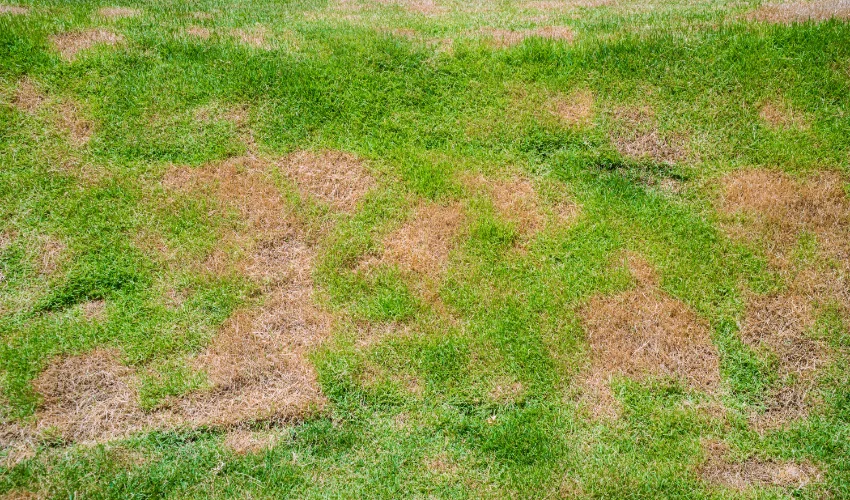
Brown patch fungus shows up as circular brown patches that look a lot like dead grass. Common in regional warm-season turf species like St. Augustinegrass, Zoysia, Bermudagrass, and Centipedegrass, it can show up suddenly and easily spread across an entire lawn. These patches may start out yellow, transitioning to tan and eventually brown. They will most likely appear from September to May when temperatures drop into a milder range.
If you think you’re dealing with fungus, don’t mow it; the fungus can contaminate the mower blades and spread to other parts of your yard. Also, unless you’re certain it’s actually dead grass, hold off on watering the area as well; brown patch fungus loves moisture, so watering it could help it get stronger and spread farther.
How Do You Tell If You Have Large Patch or Brown Patch?
To confirm an active fungal infection versus simple drought stress or dead grass, perform a quick leaf pull test:
- Inspect the Base: Examine the pulled tip. An active infection leaves the stem base looking dark, water-soaked, and distinctly rotted, even though the root system underneath remains firmly anchored in the soil.
- Grasp the Turf: Grab a cluster of grass blades right at the outer edge of an active yellow or brown patch.
- Tug Gently Upward: Pull lightly on the blades. If Large Patch or Brown Patch is actively infecting your lawn, the leaf blades will slide out effortlessly from the sheath with almost no resistance.
How Our Professional Lawn Fungus Treatment Works
Eliminating resilient fungal pathogens takes more than off-the-shelf lawn sprays. Our multi-step treatment process targets fungus directly at the stem crown to stop active spreading, restore turf health, and prevent future seasonal outbreaks.
- Accurate Expert Diagnosis: Our licensed technicians inspect the leaf sheaths and active disease margins to verify the exact pathogen, ensuring your lawn receives the precise treatment it needs without costly trial-and-error.
- Commercial-Grade Chemistry: We utilize professional-grade active ingredients—including systemic options like azoxystrobin and propiconazole—that absorb directly into the plant tissue to stop active infections and protect healthy growth.
- Deep Canopy Delivery: Store-bought remedies often sit harmlessly on top of the grass blades. Our high-volume liquid applications penetrate deep into the lower canopy and thatch layer where the fungus actually lives and feeds.
- Strategic Seasonal Timing: We time applications around crucial soil temperature triggers in the fall and spring, knocking down fungal spores right when environmental conditions make your lawn most vulnerable.
- Customized Prevention Plan: Alongside professional treatments, we provide customized guidance on watering windows, fertilization schedules, and thatch management to eliminate excess moisture and keep fungal disease from returning.
To schedule your free inspection and evaluation
CONTACT US TODAY
What Causes Brown Patch Fungus?
No matter how much attention you pay to lawn care, brown patch fungus can still show up. Below are some conditions that make your lawn more attractive to this fungus:
Brown patch fungus will gladly take advantage of excess water left over on your lawn. Make sure not to overwater your lawn!
Thatch is a layer of organic matter between the grass plant and the soil surface. Ideally, this layer is maintained naturally, breaking down over time to form new soil. However, if it gets too thick, it can hold too much water close to the surface and make the area more inviting for fungus. This can be solved with soil aeration.
Excess nitrogen fertilizer fuels soft, vulnerable leaf growth. Applying too much nitrogen—especially during cooler months—creates prime feeding conditions for fungal invaders like Rhizoctonia solani.
Hard soil can’t drain water quickly, which means more standing water for fungi to use.
Lawns covered in shade dry out much slower and are more likely to develop this fungus, as the lack of direct sunlight allows moisture to linger.

Leave your information below and we’ll be in touch shortly. After hours calls will be returned the next business day.
What Does Brown Patch Fungus Do?
An untreated brown patch problem isn’t just unsightly – it can also cause major health issues for your lawn. Here are a few of the things to expect if you don’t treat your problem quickly:
Fungi grow fast, and brown patch is no exception. It can take over large areas rapidly, getting harder to control as it grows.
Large Patch rots grass at the base of the leaf sheath and stem crown, weakening top growth and killing off foliage while leaving root systems intact.
Your lawn will look worse the longer you go without treating the problem.
With a fungus leaching its resources and killing its leaves, your lawn will be more susceptible to other problems, like pests and other diseases.
How Can I Prevent Brown Patch Fungus?
Prevention is the strongest tool against brown patch fungus. The best way to handle it is to call on the professionals at Arrow Environmental Services for proper treatment. However, there are a few steps you can take to reduce your chances:
- Proper watering schedule: Watering your lawn too much or at the wrong time of day can make fungus more likely.
- Consider targeted fungicides: Professional-grade fungicides containing active ingredients like azoxystrobin, propiconazole, or fluoxastrobin must be used carefully in order to be effective. Using the wrong product or applying it improperly could do more harm than good, so consult with a lawn care specialist before use.
- Maintain a healthy lawn: Remember to keep up proper mowing, fertilization, and aeration in addition to watering! This will give your lawn better chances against brown patch and other fungi.
- Re-sodding with resistant turf: When replacing damaged areas of St. Augustinegrass, Zoysia, Bermudagrass, or Centipedegrass, consider re-sodding or plugging with a grass variety that offers stronger resistance to disease. No warm-season grass is immune to this fungus, but certain cultivars stand up to it more effectively.
At Arrow Environmental Services, we’re always ready to help you with your pest control needs. Contact us for a free, no obligation quote, or call us at 800-226-3139 to get started today.
Leave your information below and we’ll be in touch shortly. After hours calls will be returned the next business day.
Call Arrow Environmental Services to Eliminate Fungus from Your Florida Lawn!
Every Florida lawn presents a unique ecological balance, and misdiagnosing active turf disease often leads to ineffective treatments and accelerated grass decline. Rather than risking costly trial-and-error DIY methods, partnering with lawn care specialists who understand regional soil dynamics, turf species, and targeted fungicide rotation ensures a lasting recovery.
If you are struggling with active lawn disease and need reliable brown patch fungus control in Florida, Arrow Environmental Services’s licensed specialists are equipped to restore your turf.
Ready to get started? Give us a call and we’ll set you up with a free quote.